TABLE OF CONTENTS
• A WELCOME FROM FIRSTWORKS
• AMERICAN RAILROAD PROGRAM NOTES
• ABOUT FIRSTWORKS
• SPONSOR CREDITS
• COMMUNITY PARTNERS
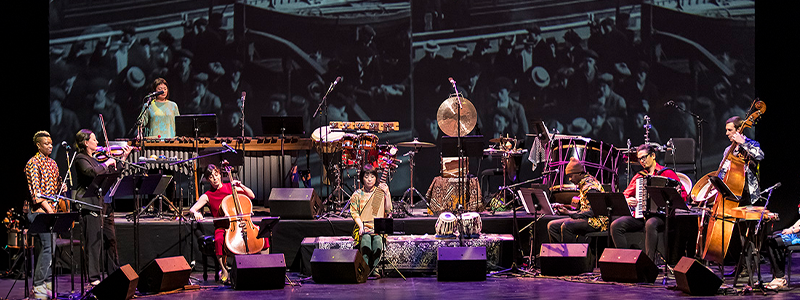 Photo credit: David Bazemore
WELCOME FROM THE EXECUTIVE ARTISTIC DIRECTOR OF FIRSTWORKS
 For almost 22 years, FirstWorks has connected artists and audiences through extraordinary performances that remind us of our shared humanity. Each project invites discovery and dialogue—illuminating how art can weave us together across cultures, histories, and generations.
Tonight’s concert by the Silkroad Ensemble embodies that spirit. American Railroad reimagines the building of our nation through music, amplifying the voices and stories that shaped its tracks.
We are honored to share this experience with you—an evening of artistry, reflection, and connection.
Kathleen Pletcher
Executive Artistic Director and Founder
FirstWorks
MORE WAYS TO ENGAGE
Watch a “Behind the Music” artist talk with Silkroad artists Wu Man and Sandeep Das (opens in new tab)
Visit the Silkroad Website for more American Railroad resources (opens in new tab)
FirstWorks
presents

Silkroad Ensemble with Wu Man
American Railroad
FEATURING ARTISTS
Wu Man, pipa
Niwel Tsumbu, guitar
Shawn Conley, bass
Sandeep Das, tabla
Kaoru Watanabe, Japanese flutes and percussion
Michi Wiancko, violin
Guo Yazhi, Chinese winds, Chinese percussion
Francesco Turrisi, accordion, frame drums
Silkroad’s American Railroad project sheds light on the profound yet often-overlooked contributions of Indigenous and African Americans, as well as Chinese, Irish, Japanese, and other immigrant communities to the construction of the U.S. Transcontinental Railroad and connecting railways across North America. Just as the ancient Silk Road facilitated cultural exchange between Asia and Europe, the railroad transformed the American landscape—both uniting and dividing the people whose lives it touched. While these laborers played a fundamental role in one of the 19th century’s most significant technological and economic achievements, their stories have too often been erased from history. At the same time, the railways had a devastating impact on Indigenous communities, displacing people from their ancestral lands.
Now, in a powerful reimagining of this acclaimed program, Silkroad presents an intimate yet dynamic eight-piece ensemble, led by internationally renowned pipa master, Wu Man. The program highlights thrilling collaborations of traditional percussion instruments from India, Japan, and Italy, alongside the exquisite tonal interplay of Chinese pipa, guitar, string instruments, and of course the unforgettable wild Chinese wind instrument suona and European accordion. With breathtaking musicianship and evocative melodies, this Grammy Award-winning group challenges conventional narratives, unveiling a deeply human perspective that redefines the American experience and transports audiences through a cultural and historical odyssey. Featuring original compositions by Silkroad artists and guest composers, this performance amplifies the voices of those who built the railroads—and those who were displaced by them—painting a richer, more accurate picture of America’s past and its reverberations today.
Beyond the stage, the story of American Railroad is available in a podcast, an educational curriculum, an album, and a PBS series, My Music with Rhiannon Giddens. As featured in The New York Times, this project challenges modern perceptions of American identity by illuminating histories too often left untold.
The ensemble, led by Wu Man, features tabla legend Sandeep Das, Congolese guitarist Niwel Tsumbu, Chinese suona player Yazhi Guo, bassist Shawn Conley, percussionist and Japanese flute player Kaoru Watanabe, violinist Michi Wiancko, and Italian multi-instrumentalist Francesco Turrisi.
Note: This program does NOT include Rhiannon Giddens.
Program
Taiko/Suona duo: Fanfare by
Kaoru Watanabe & Guo Yazhi
Hobo Signs
Composer, Kaoru Watanabe
“Hobo” refers to migrant workers in the Depression Era. The origins of the term are unclear, whether coming from “hoe boy” (because they would often carry tools with them), “homeward bound” (many fell into this lifestyle while returning home after the Civil War) or “ho, boy!” a common greeting. The term can be used in a derogatory manner, especially when referring to a person experiencing homelessness. In literature and fiction, the hobo was sometimes seen as a romantic figure who chose to live a life of freedom and often possessed deep wisdom, resourcefulness, and a strong moral compass.
“Hobo signs” refers to a vast collection of Depression-era symbols, crudely scratched onto walls and signposts by and for migrant workers that contained valuable information to fellow travelers. Watanabe learned of hobo signs while doing research for the American Railroad project and was captivated by these simple drawings which contained information pertaining to matters of life and death: beware of dog, a man has a gun, work available, medical care offered for free and countless others. These symbols were used all over the United States. To Watanabe, the act of leaving these symbols was an expression of empathy, humanity and community towards complete strangers the inscribers would never meet.
Musicians use art to process and develop their understanding of the world. When Watanabe learned of the hobo signs, he experimented: he showed a series of them to his fellow Silkroad Ensemble members and they improvised musical interpretations of the signs. This composition is a development of that initial experiment, a way for the musicians and audience alike to interact intimately with these symbols from the distant past.
The Donkey’s Frolic
Traditional, Arr. Guo Yazhi and Wu Man
Tabla Solo – Sandeep Das
Rela
Composer, Sandeep Das
Rela is an homage to the railroad workers of the Indian subcontinent who toiled to develop the country’s massive network of railways in the 19th and 20th century during the British Raj (the era in which India was under British colonial rule). Many parallels can be drawn between the American Transcontinental Railroad and the British development of railroads in India, with both undeniably marked by a complex web of history, modernization, and exploitation in the name of industrial progress.
This piece was inspired by chants attributed to the railroad workers of that era and incorporates a traditional Tabla rela, which is a type of improvisatory composition renowned for its high speeds, virtuosity, and cascades of complex notes and rhythms. The Hindi term rela comes from the word “rail” or “train”, and it is believed that modern Tabla relas were created to mimic the sounds of the first Indian railways.
Rela begins by evoking the sound of railroad crossings through a layer of complex rhythms on metallic instruments such as the triangle, gradually unveiling the sounds of deeper drums as the “train” embarks. Primarily a percussion ensemble piece, it is accompanied by a nagma (a looping melody that traditionally accompanies percussion performances in North Indian Classical music) composed in Raga Bhairavi, and features a variety of Indian percussion instruments such as the tabla (a set of two hand drums from North India), morshung (a South Indian metal percussion instrument played with the mouth, also called a “jaw harp” or “mouth harp”), and kanjira (a small frame drum prevalent in South Indian music) and incorporates instruments like the Piano Accordion, Marimba and Japanese Taiko Drums. The piece concludes with an exciting tukda (genre of fixed tabla composition) that dances between multiple instruments in a fiery finale.
Swannanoa Strings
Traditional, Arr. Silkroad Ensemble: Shawn Conley, Michi Wiancko, Francesco Turrisi
Solo Pipa by Wu Man
Rainy Day
Traditional, arr. Wu Man
This piece was originally brought by our pipa player Wu Man. Based on a folk tune popular in Guangdong in southern China, the piece tells a historical story of the Chinese railroad workers, with a slow and soulful melody expressing how the wives and mothers miss their husbands and sons who were building the railroad on the other side of the Pacific Ocean.
English Lyrics:
Rainy day, Rainy day oh the
rain falls on my side without
raincoat nor a hat on
drenched in rain oh so pitiful
Chinese Lyrics:
落水天喽 落水天喽
落水落到
我身边喽
湿了衣裳 又无伞喽
光着头来 真可怜喽
Two Chinese Paintings
Composer, Wu Man
Two Chinese Paintings is a two-movement suite, resembling a set of portraits of traditional cultures from around China. In Chinese traditional music, instrumental pieces often have poetic titles to express their content and style. I decided to continue this tradition with this collection. The inspiration for these suites came from styles of traditional music in China familiar to me, including a pipa scale from the 9th century, and the Silk-and-Bamboo music, or teahouse music, from my hometown of Hangzhou.
“‘Ancient Echo,’ the first movement of Two Chinese Paintings, is based on a scale found among the oldest tunes for pipa. The second movement, ‘Silk and Bamboo’ is a variation on the tune ‘Joyful Song’ (Huanlege) from the collection of Silk-and-Bamboo.
The original piece was composed for the Kronos Quartet’s 50th For The Future project. Tonight’s version was specially adapted for the Silkroad AR tour.
Rolling Models: 59th Street Junction
Composer, Shawn Conley
Rolling Models: 59th Street Junction is a piece about how our perception of people and events can change over time.
My maternal grandfather worked on trains his whole life- first professionally, and then as a passionate hobbyist. He designed, built, and sold trains, and even after his retirement he’d spend hours at the local track. My grandparents lived on NW 59th street in Oklahoma City, and during visits over summer break I spent the long hot days riding a miniature model train on the track that he had laid around their backyard.
I remember watching in awe as my grandfather worked, bringing the trains to life. It was pure magic. It seemed like he could build anything, and that skill felt like a superpower. But as I grew up, I came to see a fuller picture of him. He came of age at a time when fathers and grandfathers were strict and stern; he’d greet me with a handshake, not a hug. What began as simple admiration evolved into something more complicated—still full of love and respect, but reshaped into a fuller, more complex picture.
That same shift happened for me during Silkroad’s American Railroad project as I learned more about the countless immigrant laborers that never got the recognition they deserved. The history I learned in school told a story of progress and great achievement. Now, exploring that history with new knowledge, I realize that the story I was told was simplified and incomplete, while the truth is infinitely more complex. When we start to see the contradictions, costs, and the hidden voices that were left out, it can lead us to further inquiry and self-reflection. What else have we taken for granted?
The music reflects this idea of changing perspectives over time. A single melody is repeated over the course of the piece. Each time its surroundings are different—new harmonies, new textures, new rhythms. It’s like revisiting the same story at different points in life and seeing new meaning each time. Elsewhere in the piece, the music draws energy from trains themselves: the push of rhythm, the momentum of wheels turning, the sense of being carried forward.
In the end, Rolling Models: 59th Street Junction conveys both the simple joy of a child of riding a train, and the harder truths that come with looking back at history. As I consider my own roles – as a musician, global citizen, and father to a young boy – I hope I keep on learning with an open mind and open heart.
Milimo
Composer, Niwel Tsumbu
“Milimo” is a Lingala word meaning spirits.
It was inspired by a repetitive riff that I played to my grandmother on an antique Congolese instrument known as the Zande harp. I didn’t know much about the Zande harp except it’s something people use as a decoration in the house. Once on a holiday trip to Congo from Ireland where I am based, I bought one as a souvenir and took it to visit my grandmother. She was lying down very sick getting ready to transition into the next life, but she suddenly got really happy when she saw me playing it. She told me that she hasn’t seen one in many years. It used to be a very popular instrument but very quickly got out of fashion with the rise of the guitar in the 1940s.
I went back to Ireland and she passed not long after that. That is when the inspiration came to me to expand the riff that I played to her into a full composition on the guitar to her homage. I call it “Milimo” because every time I play it I see her smiling and in a broader sense I feel like it connects me to an ancient Congolese sentiment that’s nearly extinct now.
I thought it would fit in well in this project as it was inspired by the Zande harp which would have been a popular instrument during the American railway constructions. Also it sounds much closer to the banjo than the crystal clear and resonant harp sound as we know.
I feel very honored and grateful Rhiannon Giddens asked me to bring a part of this project in its initial tour and am glad to be performing it again in 2025. Thanks very much to all the wonderful Silkroad musicians for learning it and bringing it to life. Last but not least, special thanks to Shawn Conley who took his time to score it out for everybody.
I dedicate it to my grandmother who I know will be watching, smiling and dancing from the spirit world.
ABOUT SILKROAD
A Grammy Award-winning musical ensemble, Silkroad is a collective of artists representing dozens of nationalities, traditions and ideas, who use music and art to demonstrate how great beauty can emerge from great difference. The Ensemble strives to engage difference, sparking radical collaboration and music with a purpose, for a more hopeful and inclusive world.
ABOUT WU MAN
 Wu Man belongs to a rare group of musicians who have redefined the role of their instruments, in her case, the pipa, a pear-shaped, four-stringed Chinese lute with a rich history spanning centuries. Not only is she recognized as the foremost pipa player in the United States, but she is also celebrated as an accomplished composer, educator, and one of the most prominent instrumentalists of traditional Chinese music. She has premiered hundreds of new works for the pipa, while spearheading multimedia projects to both preserve and create awareness of China’s ancient musical traditions. Her adventurous spirit and virtuosity have led to collaborations across artistic disciplines, allowing her to reach wider audiences as she works to cross cultural and musical borders.
Wu Man has performed in solo recitals, with major orchestras, and at festivals around the world. She regularly collaborates with ensembles such as the Kronos Quartets and The Knights, and is a founding member of the Silkroad Ensemble. She has appeared on nearly 50 recordings, including numerous Grammy Award-winning and -nominated albums. Wu Man has premiered works by renowned composers including Tan Dun, Philip Glass, Lou Harrison, Zhao Jiping, Lei Liang, Terry Riley, Bright Sheng, and Chen Yi. Most recently, she premiered Du Yun’s pipa concerto Ears of the Book with The Knights at Carnegie Hall, followed by performances with the Detroit and New Haven Symphonies, and will perform the concerto with the Philadelphia Orchestra during the 2025-26 season.
Wu Man’s accolades include the 2023 National Heritage Fellowship from the National Endowment for the Arts (NEA), one of the highest honors in folk and traditional arts, as well as the Asia Society’s 2023 Asia Arts Game Changers Award, which recognizes outstanding contributions to contemporary art. In 2021, she received an honorary Doctorate of Music from the New England Conservatory and an Honorary University
Fellowship from Hong Kong Baptist University. She was also named Musical America’s 2013 “Instrumentalist of the Year,” the first time this prestigious award was given to a player of a non-Western instrument.
Born in Hangzhou, China, Wu Man studied at the Central Conservatory of Music in
Beijing, where she became the first recipient of a master’s degree in pipa. At age 13, she was recognized as a child prodigy and a national role model for young pipa players. She is currently a Visiting Professor at her alma mater the Central Conservatory of Music in Beijing and a Distinguished Professor at the Zhejiang and the Xi’an Conservatories. For more information visit wumanpipa.org.
Niwel Tsumbu
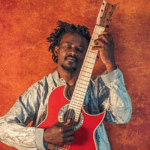 Guitar
Niwel Tsumbu is a Congolese-born, Ireland-based guitarist with a virtuosic style drawing on jazz, classical, rock, folk and rumba. He has earned praise from All About Jazz for his ‘exquisite and almost seamless’ global fusion and has performed with Sinéad O’Connor, Buena Vista Social Club and Baaba Maal.
Tsumbu’s music is anchored in his sophisticated sense of rhythm, his virtuosic guitar playing and his thrilling improvisations. He is in high demand as an African guitar teacher for the World Music Method, and his popular Instagram reels and videos garner hundreds of thousands of views. In 2021, Tsumbu’s global reach was cemented with his guitar work on the Grammy Award-winning album They’re Calling Me Home by Rhiannon Giddens and Francesco Turrisi.
At times, Tsumbu’s music is a deep emotional well, drawing joy and sadness from universal human waters. At other times, it’s a high-tech vehicle flashing with excitement across nations, continents, and the cosmos.
Shawn Conley
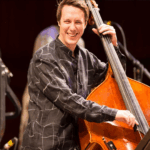 Bass
Bass
Hawaii born bassist and composer Shawn Conley grew up loving all types of music.
This love of diversity of sound developed into a career that straddles many genres. He has been a member of the Silkroad Ensemble (founded by Yo-Yo Ma) since 2013 and is a member of the Brooklyn-based chamber orchestra, The Knights.
Recently, he won the principle bass position in the Hawaii Symphony Orchestra. Shawn will be releasing his first solo bass record this year, pairing Bach’s first cello suite with freely improvised pieces, exploring the connection between the two words.
As a studio musician, he has performed on multiple soundtracks including True Grit, Moonrise Kingdom, Extremely Loud and Incredibly Close, The Vietnam War documentary by Ken Burns and the Amazon series The Marvelous Mrs. Maisel.
Shawn studied at Rice University with Paul Ellison and in Paris, France with Francois Rabbath. He currently lives in Honolulu with his wife Megan and their son, Osian.
Sandeep Das
 Tabla
Tabla
A Guggenheim Fellow, Sandeep Das is one of the leading Tabla virtuosos in the world today. Since his debut concert at the age of 17 with legendary Sitar player Ravi Shankar, Das has built a prolific international reputation spanning over three decades. He has collaborated with top musicians, ensembles, and orchestras from all over the world, and his original compositions have been performed in 50+ countries. Das is the founder of Harmony and Universality through Music (HUM), a nonprofit organization in India that has promoted global understanding through music performance and provided learning opportunities and scholarships for visually-impaired children with artistic potential since 2009. His most recent project, Transcending Borders One Note at a Time, launched in 2020 to widespread international acclaim, and seeks to harness the power of music to create positive social change.
Kaoru Watanabe
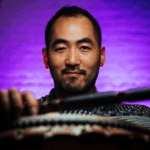 Japanese Flutes and Percussion
Acclaimed composer and instrumentalist Kaoru Watanabe’s work is grounded in traditional Japanese music while imbued with jazz, improvisation, and experimental music elements. His signature skill of merging the music, literature, and aesthetic philosophies of Japan with disparate styles and mediums has made him a much-in-demand collaborator working with such iconic artists as André 3000, Yo-Yo Ma, Wes Anderson, Mikhail Baryshnikov, Laurie Anderson, Jason Moran, and Japanese
National Living Treasure Bando Tamasaburo. A trained jazz musician, he became the first American to become a performer and artistic director of the ground-breaking Japanese taiko performing arts ensemble Kodo. In 2024, Watanabe launched Bloodlines Interwoven, a multifaceted festival and ensemble celebrating diaspora through music and storytelling, presented by Baryshnikov Arts and funded by the Mellon Foundation.
Michi Wiancko
 Violin
Michi Wiancko is a multifaceted and imaginative composer, violinist, teacher, and collaborator, whose creative projects and organizational work are driven by creative exploration, community resilience, and social change. Recent commissions include works for Boston Chamber Music Society, Carnegie Hall’s Ensemble Connect, NOW Ensemble, Parker Quartet, Seattle Chamber Music Society, Orpheus Chamber Orchestra, The Met Museum, American Lyric Theater, Experiments in Opera, and American Ballet Theater.
An accomplished violinist and Juilliard graduate, Michi was described by Gramophone Magazine as an “alluring soloist with heightened expressive and violinistic gifts” and has toured and collaborated with countless artists across numerous genres and styles.
Michi’s concerto debut performances with both the Los Angeles and New York
Philharmonics were met with critical acclaim as were her two solo albums released on New Amsterdam Records and on Naxos. Michi is Artistic Director of Antenna Cloud Farm, a genre-fluid and culturally expansive music festival, artists’ retreat, and community partnership organization based in Western Massachusetts. ACF also hosts The Experimental Institute, a tuition-free summer intensive for early-career musicians focused on creative artistry, career mentorship, and community resilience. Michi teaches privately, and is also Associate Professor of Music at the Boston Conservatory at Berklee.
Yazhi Guo
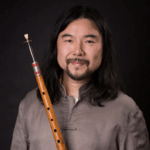 Suona, Chinese winds and Percussion
Co-founder and founding President of the American Academy of World Music, Yazhi Guo, is recognized by the industry as one of the best suona performers in the world, and he is committed to integrating Chinese music with world music.
Francesco Turrisi
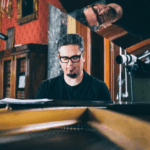 Frame Drums, Accordion
Francesco Turrisi is a Grammy award winner multi-instrumentalist, celebrated by the press as a “musical alchemist” and “polyglot.” Turrisi has released several critically acclaimed albums and performs regularly with The Silkroad ensemble and ensemble L’Arpeggiata. He collaborates with Rhiannon Giddens, blending Mediterranean and
African diaspora music. Their duo album “They’re Calling Me Home,” has received a
2023 Grammy award for best folk album.
He has performed and recorded with Bobby McFerrin, Ben Harper, Dave Liebman, Bill Frisell, Christian McBride, and Taj Mahal.
ABOUT FIRSTWORKS
FirstWorks is a non-profit based in Providence, Rhode Island whose purpose is to build the cultural, educational and economic vitality of its community by engaging diverse audiences with world-class performing arts and education programs. Now entering its 22nd year, FirstWorks festivals, performances and programs have attracted more than one million participants since its founding in 2004. Reaching students in school districts across the state, FirstWorks has impacted over 23,000 youth through transformative arts education experiences. FirstWorks is the founding partner of PVDFest and has collaborated with the City of Providence to curate and produce the City’s free, signature arts celebration since 2015. Embracing collaboration, FirstWorks has fostered over 90 community partnerships across business and social service sectors. Across its 2024-25 season, FirstWorks produced over 60 events, employed more than 400 artists, and reached upwards of 3,300 Rhode Island youth. Visit firstworks.org to learn more.
FOR FIRSTWORKS STAFF LIST AND BOARD OF DIRECTORS – CLICK HERE
FUNDING CREDITS
Funded in part by the New England States Touring program of the New England Foundation for the Arts, made possible with funding from the National Endowment for the Arts Regional Touring Program and the six New England state arts agencies. Additional support from City of Providence Department of Art, Culture and Tourism, Papitto Opportunity Connection, The Carter Fund at the Rhode Island Foundation, Rhode Island State Council on the Arts, Rhode Island Foundation and Secretary of State Gregg M. Amore and the Rhode Island Semiquincentennial Commission.
Additional support for Silkroad: Behind the Music virtual artist talk provided by Rhode Island Commerce.






THANK YOU TO ALL OF OUR FIRSTWORKS SEASON SPONSORS – VIEW ALL BY FOLLOWING THIS LINK
COMMUNITY PARTNERS

AUREA
The mission of Aurea is to investigate and invigorate the relationship between music and the spoken word. Aurea aspires to unify the humanities and fine arts in dynamic, accessible & engaging ways through performance and educational outreach. Aurea’s concerts combine poetry with classical, folk and contemporary music, to create performances that sweep from intimate chamber settings to major theatrical venues. Aurea approaches cross-cultural themes in their programming believing the arts inform our understanding of these issues.
Aurea takes its name from Catena Aurea Homeri, or the Golden Chain of Homer, a symbol of 18th century esoteric alchemy, which strove for the refinement of the human condition. That alchemy – combining disparate elements into a divine new element – defines every Aurea event.
Their eclectic humanities-based repertoire, featuring an extraordinary string ensemble, is built on a strong musical framework of original or previously composed music with eloquent spoken word including poetry, journals, and prose; laced together with soaring harmonica improvisations. Aurea collaborating guest artists have included musicians, actors, puppeteers, dancers and visual artists. Learn more at https://aureaensemble.org/
 RHODE ISLAND BLACK HERITAGE SOCIETY
The Rhode Island Black Heritage Society is dedicated to collecting, preserving, and sharing the history of people of African heritage in Rhode Island. Established in 1975, RIBHS safeguards one of the oldest and most comprehensive collections of African American materials in the state, including rare books, photographs, manuscripts, and personal artifacts. These collections tell the powerful stories of resilience, achievement, and community that have shaped Rhode Island’s history. Through exhibitions, public programs, and educational initiatives, the Society ensures these stories are accessible to all, fostering dialogue, pride, and a deeper understanding of the state’s diverse heritage. Learn more at: https://www.riblackheritage.org/
 RHODE ISLAND BLACK STORYTELLERS
Founded in 1998, RIBS is a non-profit based out of Providence, Rhode Island dedicated to promoting the awareness, appreciation, and application of Black storytelling. They define Black storytelling as an oral art from African and African descended people from around the world. They share their craft through performances, workshops, cultural, educational, and historical experiences. RIBS does not just tell Black stories; they also aim to help others do the same. They do it not just because they believe it is important for Black communities to know their own history and culture, but for everyone to experience Black culture presented by Black people. Be sure to join RIBS in January for its signature event, FUNDA FEST: A Celebration of Black Storytelling. Learn more at https://ribsfest.org/
 STAGES OF FREEDOM
Founded in 2016, Stages of Freedom is an award-winning non-profit that has at its core addressing racial inequities in Rhode Island and ensuring that Black Lives Do Matter. We do this through:
1) Swim Empowerment, a multi-awarded statewide program that provides no-cost swimming lessons to RI African American youth, who drown at five times the rate as white youth, at nine partnering YMCAs.
2) Cultural and arts events and workshops, such as Bow Ties for Boys, Girls Tea Party, and Jazz is a Rainbow, to empower Black youth.
3) Programs that promote and celebrate African American history and culture and build bridges of understanding across the racial divide.
4) A Museum of Rhode Island African American history and non-profit bookshop, proceeds from which help fund Swim Empowerment.
5) Environmental Justice through its tree planting initiative for South Providence.
6) Dissemination of Black history and events presented through its daily e-blast, “Connected.” (Email: StagesofFreedom@aol.com to receive it.)
Learn more at https://www.stagesoffreedom.org/